
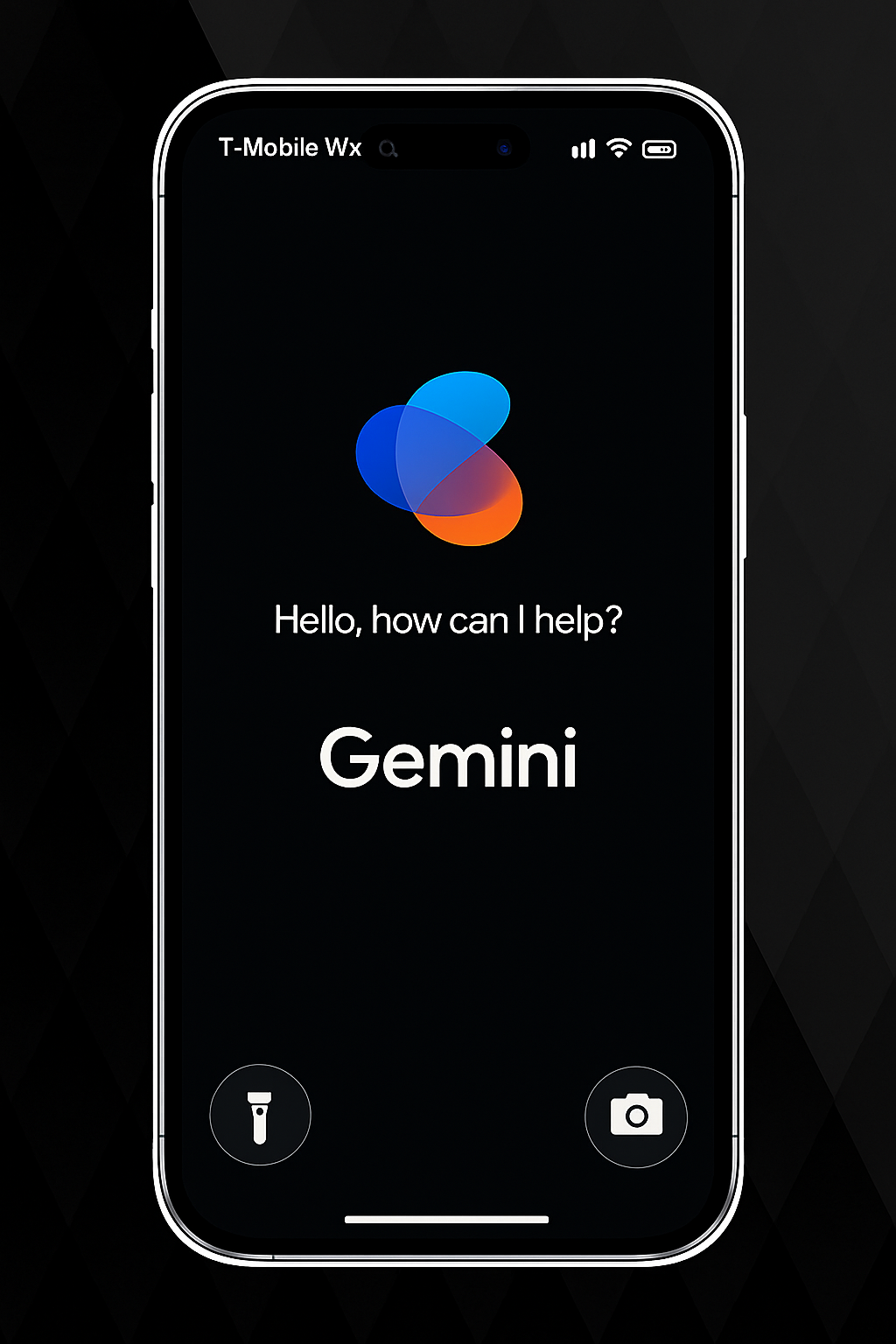

Apple just made one of the most important technology deals in its recent history, and most people will never know it happened. The company is finalizing an agreement with Google to pay roughly $1 billion per year to use a custom version of Gemini, Google's large language model, to power the next generation of Siri that launches in spring 2026.
This represents a massive shift in how Apple approaches artificial intelligence. After years of building everything in house, Apple is admitting through its checkbook that it needs help from one of the world's leading AI companies to make Siri competitive again.
The deal centers on Google's 1.2 trillion parameter version of Gemini. Parameters measure how much information an AI model can process and understand. For context, Apple's current cloud-based Apple Intelligence model uses only 150 billion parameters. Google's model is roughly eight times more complex and capable.
Under this arrangement, Gemini will handle Siri's summarization and planning functions, the components that help the voice assistant understand complex requests and decide how to execute multi-step tasks. Apple's own models will still power some Siri features, particularly those focused on personal data that never leaves your device.
The most important detail for privacy-focused Apple users is this: Google's Gemini model will run entirely on Apple's Private Cloud Compute servers. Your data stays within Apple's infrastructure. Google never sees it, never touches it, and never gets access to it. This is fundamentally different from using Google's Gemini app directly.
Apple tested several options before landing on Google. The company evaluated models from OpenAI, whose ChatGPT currently serves as an optional extension for Apple Intelligence, and Anthropic, whose Claude model also competed for this role. According to reports, Anthropic actually performed slightly better in Apple's testing, but the company wanted more than $1.5 billion per year, making Google the more financially sensible choice.
The timing makes sense when you look at Apple's broader AI struggles. Apple Intelligence launched with iOS 26 back in September, but the promised overhaul of Siri kept getting delayed. Apple showed demos of a smarter Siri at WWDC 2024, then pulled back when the technology wasn't ready. The company even stopped running ads about improved Siri features when it became clear those features wouldn't ship on schedule.
This Google deal is Apple's solution to that problem. Instead of waiting years to develop its own trillion-parameter model from scratch, Apple is essentially renting Google's technology as a stopgap while it continues working on its own long-term AI solution. Apple is reportedly developing a 1 trillion parameter cloud-based model that could be ready as early as late 2026, at which point the company could transition away from Google's technology.
For everyday iPhone users, this changes what Siri can actually do. The current version of Siri struggles with context, often fails to understand follow-up questions, and can't handle multi-step requests reliably. The Gemini-powered version launching next spring should fix those problems. You'll be able to ask Siri to find that book recommendation your mom texted you last month, book a dinner reservation at a nearby restaurant with outdoor seating, and add it to your calendar with a reminder, all in one natural conversation.
The deal also includes AI-powered web search capabilities, which means Siri will be able to pull in current information from the internet to answer your questions, similar to how ChatGPT works today but integrated directly into Siri without needing to invoke a separate extension.
Neither Apple nor Google is expected to publicly acknowledge this partnership. That makes sense for both companies. Apple doesn't want consumers thinking Siri is just Google in disguise. Google doesn't want to explain why the Gemini integration in Siri is different from the full Gemini experience available through Google's own apps. The arrangement will simply exist behind the scenes, with Apple marketing everything as its own technology running on its own servers with its own interface.
This follows a pattern Apple has used before. The company leaned on Google Maps until Apple Maps was ready. It used Weather Channel data until it built its own weather infrastructure. It relied on Intel and Qualcomm chips until Apple Silicon launched. Apple often uses external technology as a bridge to buying itself time to develop the right in-house solution.
The question now is whether this Gemini-powered Siri can undo years of damage to the Siri brand. Many iPhone users have simply stopped trying to use Siri for anything beyond timers and phone calls because they've been burned so many times by unhelpful or incorrect responses.
What makes this particularly interesting is the existing relationship between Apple and Google. Google already pays Apple over $20 billion per year to be the default search engine in Safari. Now Apple is paying Google $1 billion yearly for AI capabilities. The two companies remain both partners and competitors, with Google providing essential infrastructure for Apple's ecosystem while simultaneously competing against iPhones with its Pixel phones and against Apple's services with its own offerings.
For users preparing for this new Siri, the hardware you already have should work fine. Any iPhone capable of running iOS 26 will support the upgraded Siri when it arrives in spring 2026. However, since the new Siri will rely more heavily on cloud processing through Private Cloud Compute, having a stable internet connection will matter more than it does today.
If you want to make sure your iPhone is always charged and ready to take advantage of the new Siri capabilities, a reliable wireless charger helps. The Apple MagSafe Charger with its 2-meter cable provides up to 25W fast charging for iPhone 16 and 17 models, bringing your phone to 50 percent battery in around 30 minutes when paired with a 30W USB-C power adapter. The longer cable gives you flexibility to use your phone comfortably while it charges.
Where you can get the Apple MagSafe Charger 2m with fast charging capability https://www.amazon.com/dp/B0DGHHJXTC?tag=nextlevelmac-20&gbOpenExternal=1
For those who prefer a more versatile charging setup, the Belkin MagSafe 2-in-1 Wireless Charging Stand charges both your iPhone and AirPods simultaneously. It supports up to 15W fast charging for compatible iPhones and uses MagSafe technology to ensure perfect alignment every time you place your phone on the stand.
This is where to buy the Belkin MagSafe 2-in-1 Wireless Charging Stand https://www.amazon.com/dp/B091J7B6X7?tag=nextlevelmac-20&gbOpenExternal=1
The broader implications extend beyond just Siri. This deal signals that Apple recognizes it cannot go it alone in the AI race. The pace of development in large language models is too fast, and the investment required is too large, for any one company to dominate without strategic partnerships. Apple is choosing to be pragmatic rather than purely proprietary.
It also raises questions about what happens when the spring 2026 launch arrives. Will the new Siri actually work as promised? Can it handle the complex, multi-step tasks that current Siri fails at routinely? Will it feel fast enough that people actually want to use it instead of just typing what they need? And perhaps most importantly, will it be reliable enough that users start trusting Siri again after years of disappointment?
The $1 billion price tag seems like a bargain when you consider Google has reportedly invested over $100 billion developing its AI capabilities. Apple is essentially getting access to that entire research and development effort for one percent of what it cost Google to create. That's the kind of deal that makes sense for a company trying to catch up quickly in a space where it fell behind.
Looking ahead to 2026 and beyond, this Gemini partnership sets the stage for a more capable iPhone experience. Siri should finally be able to compete with Alexa, Google Assistant, and the growing number of AI chatbots that people turn to for complex questions. The integration with Apple's ecosystem, your personal data, and your apps should give Siri advantages those other assistants cannot match.
But success is not guaranteed. Apple has promised Siri improvements before and failed to deliver. The company pulled Siri ads when features didn't materialize. Employees have expressed doubts about whether even the spring 2026 timeline is realistic. And using Google's technology, no matter how well-integrated, is still a risk if Google's models develop problems or if the partnership sours.
For now, the deal represents Apple's best path forward. It gives the company access to world-class AI technology immediately, maintains user privacy through Apple's own server infrastructure, and buys time for Apple's own AI teams to develop a competitive alternative. Whether that gamble pays off depends entirely on execution, something Apple has not always delivered when it comes to Siri over the past decade.
The spring 2026 launch will be the moment of truth. Either this Gemini-powered Siri will finally deliver on years of broken promises, or it will become another chapter in Siri's long history of underwhelming updates. Apple is betting a billion dollars a year that it will be the former. iPhone users around the world are hoping Apple is right.

Related Posts
Finder Quick Actions in macOS Tahoe Automate File Tasks Instantly
Jan 12, 2026
Master Pixelmator Pro: The Ultimate Mac Photo Editor Guide
Dec 10, 2025
Keka: The Best Mac File Compressor
Dec 10, 2025